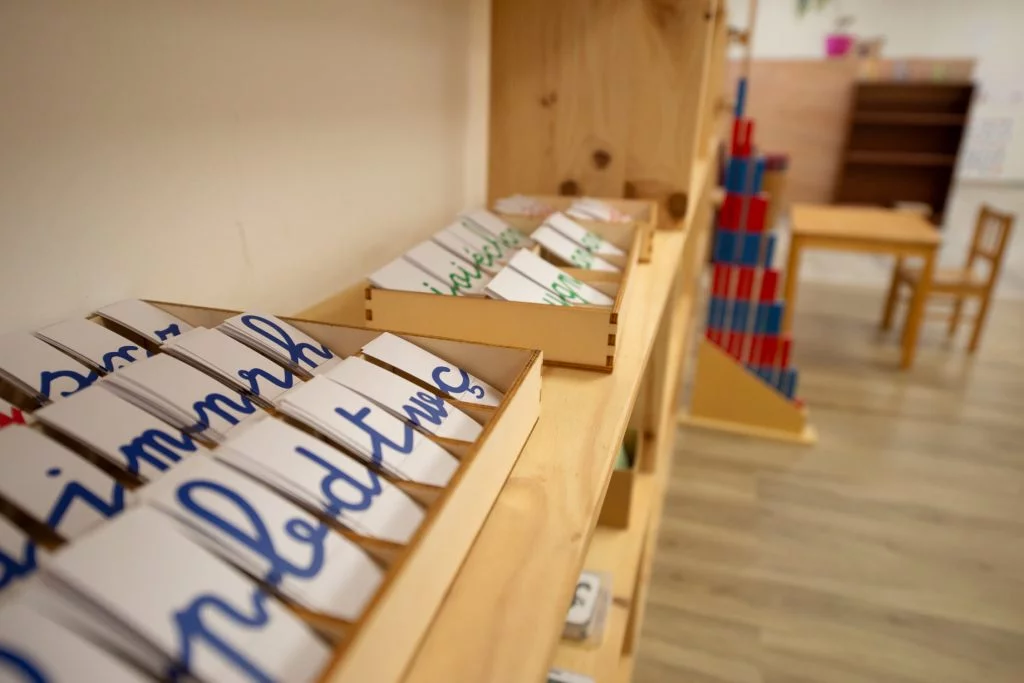
Montessori pedagogy is at the heart of the teaching we apply within the school Les Graines du Bonheur.
Maria Montessori
Born in 1870, Maria Montessori was one of the first women to graduate in medicine in Italy. Between 1894 and 1896, while she was an assistant in the psychiatric clinic of the University of Rome, she discovered with amazement the unsuitable environment in which interned children grew up. She created one of the first child psychiatric services in Italy, in which she initiated the work that would lead her in 1906 to the creation of her pedagogical method.
In 1907, she opened the first "Children's House" in Rome.
Currently, there are about 35,000 Montessori schools in the world and about 200 Montessori schools in France. Pedagogy tends to be democratized in public schools thanks to the Public Montessori association.
Montessori Pedagogy
Montessori pedagogy is based on 4 principles: the free choice of activity, respect for the rhythm of the child, learning through experimentation and self-discipline.
Let us not raise our children for today's world. This world will no longer exist when they grow up. And nothing allows us to know what world will be theirs: so let's teach them to adapt."
Maria Montessori
The Montessori child enjoys freedom within a defined framework. He must respect the rules established implicitly by the atmosphere of the class.
The educators present the activities in the form of individual trays in 3-6 years, allowing each child to evolve at his own pace in his learning.The child becomes an actor in his education and acquires autonomy. In 6-12 years, presentations can be collective or individual. The children then work as a project in small groups of 3 or 4 students or individually depending on the needs of each.
The adult has a role of observer, of educator. It guides the child in his learning, and does not make any judgment or correction in the child's work. Indeed, the pedagogical material is a scientific material, meticulously thought out and allowing a self-correction.
Error is an integral part of Montessori teaching. Thanks to the mistake, the child can progress by training.
Mixed age groups quickly induce mutual aid, motivation and cooperation between children.
What do you learn in a Montessori school?
Even if we are a private school out of contract, we are still subject to respect for the common base of National Education. However, we have the choice of pedagogy and method of instruction. Regularly, we are subject to an inspection by the Academy of Montpellier, this inspection to verify that we comply with the regulations but especially that an instruction is effective.
In the Montessori school Graines du Bonheur, children learn the same teachings as in a traditional school: French, mathematics, geometry, history, geography, science etc …
In addition to "school" teaching, children work on workshops of practical life, sensory life, botany and zoology. We do choiring, gardening thanks to our vegetable garden, dancing, theater, forest outings, art, and of course language learning thanks to daily immersion in English and Spanish and LSF workshops.
Example of a class 3-6 years
Example of a class 6-12 years
What's next? our college project
Our wish is to be able to accompany our students as long as possible. We are in the process of setting up the creation of secondary school to allow by 2024 our oldest students to continue their schooling in an alternative college in the continuity of our school.